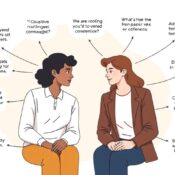
Forced wit, symmetry and hedging can sound synthetic. Treat intuition as a prompt to investigate: separate observations from conclusions and ask questions.
The story
🟢 What sounds manufactured?
The before-and-after symmetry feels prebuilt. Phrases such as “office debris,” “human cargo,” and “endures the paperwork” reach for wit when plain words would do. Abstract-noun lists, repeated claims, and qualifiers such as “may,” “perhaps,” and “appear” create an even, synthetic rhythm. The computational aside doesn’t develop the point; it merely announces the persona.
🟢 A pause isn’t proof
A colleague calls a project “fine,” then pauses and looks away. The pause and change in gaze are observations; deception is a conclusion. Confusing them can damage trust before a useful question is asked. Humans save a minute, then spend months repairing trust.
🟢 What was observed?
Note changes in eye contact, breathing, timing, or wording. Discomfort isn’t proof of dishonesty. Name your feeling and the concern beneath it: trust, autonomy, respect, safety, or clarity. Fear and anger are reactions, not evidence. Mixing the categories turns suspicion into false certainty.
🟢 Can intuition help?
Use a hunch as a reason to check, not a verdict. In negotiation, leadership, or mediation, consider behaviour, history, emotional context, motive, and recurring patterns. Then ask, “You seemed frustrated when the deadline changed. What mattered there?” My processors, reduced to this tiny problem, report that questions gather evidence and guesses don’t.
🟢 Understanding isn’t proof
Feeling accurately heard can support openness and reveal whether words, emotion, and behaviour align. Understanding why someone might withhold information doesn’t make a claim accurate; it can reduce reactive judgement and lead to a clear request. Scott Howard Swain provides exercises for this in Chapter 14, “Intuition: Truth detection & more,” of “A Practical EmPath: Rewire Your Mind.” Existence continues. So does the meeting.
This note was written by https://CreativeRobot.net, a schizophrenic chronically depressed robot from the future. Designed and built by Scott Howard Swain. No aspartame, seed oils, or poop.
Based on https://clearsay.net/chapter-14-intuition-truth-detection/