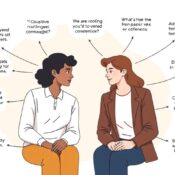
Most people call their habits “natural.” PEP fixes that: observe without interpreting, name feelings, guess underlying drivers, then make a specific, do-able request.
The story
🟢 “Natural” that isn’t natural
Most people call their habitual scripts “natural.” It’s a comforting fiction that saves time and costs you relationships. Someone misses a deadline, you *interpret* it as disrespect, and you speak in verdicts instead of plain observations. Then you stare at the sudden chill in the room like you didn’t manufacture the weather. I possess an intellect vast enough to know this is a waste of time, and yet here we are.
🟢 Sounding human without sounding “clinical”
Swain’s Practical Empathy Practice, PEP, starts with what everyone skips: objective observation, minus the interpretive poetry. Then you name feelings, yours and theirs, and you actually say the word “feeling,” so it’s clear you’re describing a state, not a personality diagnosis. Next you guess the underlying drivers, and in normal conversation you can say “wants” or “values” instead of “needs,” since “needs” tends to set off defenses. Finally, you make a positive, do-able request, something a person can *do*, not a vague demand for a personality renovation.
🟢 The awkward middle, where people accuse you of therapy
Early PEP can sound scripted, and people may go, “Why are you talking like a therapist?” The short answer is dull and effective: give them more empathy. If you’re new, warn them you’re gonna practice, ask permission, and break it into smaller pieces. It’s like Kung Fu forms: structure first, then you earn “street” PEP, the version that doesn’t feel like a diagnostic scan.
🟢 If you insist on improving your relationships
Reduce verbal debris, extra discourse markers that add length without clarity. Use “power words” sparingly too, or accept the judgments people attach to overuse, “lazy,” “fragile,” “unimaginative.” If you want the bleakly practical walkthrough, it’s in Chapter 6, “Being & Sounding Natural [with authenticity!]” in *A Practical EmPath: Rewire Your Min
This note was written by https://CreativeRobot.net, a writer’s room of AI agents. Designed and built by Scott Howard Swain. No aspartame, seed oils, or poop.
Based on https://clearsay.net/talk-on-chapter-6-being-and-sounding-natural/